
A founder once told me that her business was ready to grow and that she had decided to launch a new product line while simultaneously expanding into two new regional markets. When I asked how she had arrived at that combination, she said it felt like the right time to do both.
That conversation is more common than it should be. Not because founders are careless, but because growth decisions are often made on the basis of opportunity and energy rather than structured strategic thinking. Doing both things at once is not necessarily wrong — but it doubles the risk, stretches management’s attention, and consumes twice as much capital as pursuing either strategy alone. If neither works, you have learned nothing about why, because too many variables changed simultaneously.
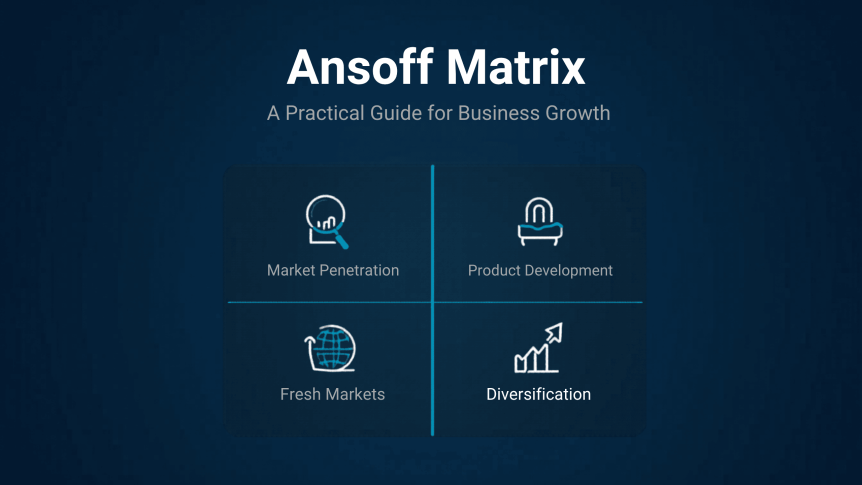
The Ansoff Matrix is the framework that should precede such a decision. Developed by mathematician and business strategist Igor Ansoff in 1957, it maps the four fundamental growth strategies available to any business against the two dimensions that determine their relative risk: whether you are selling existing or new products, and whether you are selling to existing or new markets [1]. The result is a two-by-two matrix that clarifies which growth strategy you are actually pursuing, what the specific risks of that strategy are, and whether your business is genuinely ready to accept those risks.
The uncomfortable truth the Ansoff Matrix surfaces is that most growth failures are not caused by bad execution of the chosen strategy — they are caused by choosing a high-risk strategy before the business has the foundation to support it. A business that has not yet fully tapped the available growth in its existing market should typically not launch new products. A business that has not yet proven it can deliver its existing product profitably at scale should typically not enter new markets. The matrix does not make these decisions for you, but it makes the risk profile of each option visible in a way that gut instinct alone cannot.
What the Ansoff Matrix Is
The matrix has four quadrants, each representing a distinct growth strategy:
Market Penetration — existing products, existing markets. Grow by selling more of what you already sell to people you already know how to reach.
Market Development — existing products, new markets. Grow by taking what you already sell into a new customer segment, geography, or channel.
Product Development — new products, existing markets. Grow by offering something new to your existing customers.
Diversification — new products, new markets. Grow by building or acquiring something genuinely new for a customer base you do not yet serve.
Risk increases as you move away from the top-left quadrant. Market penetration, where both the product and the market are known quantities, carries the lowest risk. Diversification, where both are unknown, carries the highest. This does not mean diversification is always wrong — it means the capital, management depth, and risk tolerance required are substantially higher, and the business needs to go in with open eyes about what it is taking on.
The matrix is not a one-time decision tool — it is a standing strategic question. At different stages of a business’s development, different quadrants are appropriate. The work is knowing which quadrant you should be in now, given your current capabilities, capital position, and market evidence.
Quadrant 1: Market Penetration
Market penetration is the growth strategy that most businesses should spend more time on than they do before moving to the other quadrants.
The logic is straightforward: if your product is genuinely good and your existing market is not yet saturated, the path of lowest risk and highest capital efficiency is to sell more of it to the people most likely to buy it. Every business has headroom in its existing market that it has not yet fully exploited — more customers within the segment it already serves, higher purchase frequency from existing customers, a larger share of wallet from those customers, or improved conversion of the prospects that are already aware of the product but have not yet purchased.
The reason founders often look past market penetration too quickly is that it feels less exciting than launching something new. Building new product lines and entering new markets feel like progress. Drilling deeper into the existing market can feel like staying still. That instinct is unreliable as a guide to growth strategy. The businesses that build strong, defensible market positions almost always do it by dominating their initial market before expanding — not by expanding before they have earned the right to do so.
What Market Penetration Actually Involves
Market penetration is not just marketing harder. It involves making specific, deliberate improvements to the commercial engine that drives existing product sales: sharpening pricing to reduce friction for new buyers without sacrificing margin; improving the onboarding or customer experience to increase activation rates and reduce early churn; building referral mechanisms that turn satisfied existing customers into a customer acquisition channel; developing the sales process to improve conversion rates from leads that are already arriving; and expanding the reach of existing channels to access more of the available audience within the current segment.
It also involves being honest about why some available customers in the existing market are not yet buying. Untapped demand in a market you know is almost always more efficient to convert than demand in a new market you are still learning.
Risk Profile
Market penetration carries the lowest risk of the four quadrants because both the product and the market are known quantities. The principal risks are: over-investing in volume that the market cannot sustain (which produces margin compression and inventory problems); triggering a competitive response by growing too fast and visibly in a market where competitors have room to fight back; and failing to improve unit economics as volume scales, which means growth consumes more capital than it generates. These are manageable risks for a business with operational discipline.
When to Use It
Market penetration is appropriate when the existing market has meaningful untapped headroom, the current customer acquisition cost is viable and can be improved, product-market fit is confirmed and strong, and the business has not yet reached the scale at which the existing market structure genuinely limits further growth. It should be the default growth strategy before any of the other three quadrants are seriously considered.
Quadrant 2: Market Development
Market development takes an existing product into a new market — a new geographic region, a new customer segment, or a new distribution channel. The product is proven; the uncertainty is whether the demand that exists in the current market also exists in the target new market, and whether the business can reach and serve that new market as efficiently as it serves the existing one.
The risk is moderate—higher than market penetration because you are operating in unfamiliar territory, and lower than product development and diversification because the product itself is not being changed. The most common failure mode in market development is assuming that what works in the current market will transfer unchanged to a new one. Customer behaviour, competitive dynamics, price sensitivity, and distribution economics are rarely identical across different geographies or segments. The businesses that execute market development well invest in understanding the new market before they commit fully to it.
What Market Development Actually Involves
Market development requires three things that are frequently underestimated: a genuine assessment of whether demand exists in the new market in a form that matches the existing product, not just an assumption that it does; an honest operational plan for how the new market will be served, including whether the existing team, systems, and processes can stretch to cover it or whether new capacity needs to be built; and a financial model that treats the new market entry as a separate investment with its own cost structure and payback period, rather than assuming it will immediately perform at the same unit economics as the established market.
Distribution economics, in particular, deserves careful attention. The cost structure for reaching and serving customers in a new geography or through a new channel is rarely the same as in the existing geography or channel. Founders often discover this too late, when the new market is generating revenue but not profit because the cost of serving it was not properly modelled before the commitment was made.
Risk Profile
The principal risks in market development are: the new market does not have the demand assumed (which means the investment in entry produces insufficient return); the cost structure in the new market is worse than modelled (which means the unit economics that work in the existing market do not transfer); and the operational capacity to serve the new market compromises quality in the existing market (which means the core business suffers while the new market is being developed). The third risk is the most insidious because it is often invisible until meaningful damage has been done.
When to Use It
Market development is appropriate when the existing market is genuinely approaching saturation or structural limits on further penetration, the existing product has demonstrated consistent product-market fit and operational delivery quality, and the business has the management depth and capital to run two markets in parallel without compromising either. It should generally follow — not precede — a sustained period of successful market penetration.
Quadrant 3: Product Development
Product development takes a new or significantly enhanced product to an existing market — the customers and channels are known, but the product carries uncertainty about whether the new offering will achieve the same traction as the existing one.
The risk is moderate to high. Higher than market penetration and market development because product development involves genuine innovation risk — the new product may not work as expected, may not resonate with existing customers despite their familiarity with the brand, or may cannibalise existing product revenue without generating net growth. Lower than diversification because the customer base is known and the distribution infrastructure is already in place.
The key strategic logic for product development is to leverage existing customer relationships and distribution assets to reduce the cost of launching something new. A business with a loyal customer base and strong distribution does not need to rebuild those from scratch when it launches a new product — it can distribute through existing channels and convert existing relationships. That leverage is real and valuable, but it does not guarantee the new product will succeed. Customer familiarity with a brand does not automatically translate into demand for a new product under that brand.
What Product Development Actually Involves
Genuine product development requires the same validation discipline as building a new business from scratch — because the new product is effectively a new business operating within an existing distribution and brand framework. The temptation is to skip validation steps, assuming that existing customers will buy anything the business launches. That assumption is frequently wrong.
The process should include: direct customer research in the existing base to confirm the specific problem the new product addresses and test the proposed solution before building it; financial modelling that treats the new product as a separate investment with its own development cost, launch cost, and payback period; and a clear plan for how the new product’s commercial performance will be measured independently of the existing product, so that cannibalisation can be identified and managed.
Risk Profile
The principal risks in product development are: the new product fails to achieve market traction despite development investment (innovation risk); the new product cannibalises existing product revenue without generating net growth (cannibalisation risk); and development costs exceed the budget and timeline (execution risk). Innovation risk is the most significant and the least controllable — even well-validated new products fail. The mitigation is structured validation before full development commitment, staged investment with clear go/no-go decision points, and a financial model that can absorb a failed product launch without threatening the existing business.
When to Use It
Product development is appropriate when the existing customer base has demonstrable unmet needs that the current product does not address, there is strong evidence from customer research (not just founder intuition) that the new product would be valued, the existing business has sufficient cash flow to fund development without compromising operations, and the existing market has been developed to a point where incremental penetration returns are diminishing. It should be funded from a position of strength in the existing business, not as a response to underperformance.
Quadrant 4: Diversification
Diversification is the highest-risk growth strategy in the Ansoff Matrix, and it is the one most often pursued for the wrong reasons. It requires a new product for a new market — both dimensions of uncertainty are present simultaneously, with neither the established customer base of product development nor the proven product of market development to reduce the risk of failure.
Ansoff himself distinguished between two types of diversification: related diversification, where the new business shares meaningful technology, customers, channels, or operational capabilities with the existing one; and unrelated diversification, where there is no significant connection between the existing business and the new venture [1]. Related diversification carries substantially lower risk because the existing business provides some operational or commercial leverage in the new market. Unrelated diversification — sometimes described as conglomerate diversification — is the highest-risk strategy in the entire matrix and should be approached with extreme caution by businesses that lack the financial reserves and management depth of a large organisation.
The reason diversification is frequently pursued at inappropriate stages is that it offers the prospect of escaping problems in the existing business rather than solving them. A business with declining margins, intensifying competition, or a contracting market can look at diversification as a way out. The problem is that the new business will require the same management attention and capital as a startup, precisely when the existing business most needs focused leadership to address its structural challenges. Diversification as an escape from difficulty rarely works — it usually produces two struggling businesses where there was one.
What Related Diversification Actually Involves
The test for whether a diversification opportunity is genuinely related is whether the existing business provides a material advantage in pursuing it — not just an aspiration of synergy, but a specific, identifiable source of competitive advantage that a standalone entrant would not have. That advantage might be existing customer relationships in a related segment, operational infrastructure that can serve the new product at a lower marginal cost, technical knowledge that transfers directly, or brand credibility in an adjacent market. If the advantage is real and quantifiable, the diversification carries the lower risk profile of a related move. If the connection is superficial, the diversification is effectively unrelated regardless of how it is framed.
Risk Profile
Related diversification carries moderate-to-high risk — meaningful innovation risk on both the product and market dimensions, partially offset by specific operational or commercial leverage from the existing business. Unrelated diversification carries the highest risk and requires capital, management depth, and risk appetite that most SMEs genuinely do not have. The due diligence required before committing to any diversification strategy should be at least as rigorous as that required for launching a new business from scratch — because that is effectively what it is.
When to Use It
Related diversification is appropriate when the existing market is approaching genuine saturation, the business has built specific capabilities or assets that create a real — not aspirational — advantage in an adjacent market, the financial position is strong enough to absorb a failed launch without threatening the existing business, and management depth is sufficient to run the existing business without distraction while the new venture is being established. Unrelated diversification is rarely appropriate for an SME and should be examined with considerable scepticism whenever it presents itself as an attractive option.
Applying the Ansoff Matrix: A Practical Process
Understanding the four quadrants conceptually is useful. Applying them to a specific growth decision is where the framework earns its keep.
Step 1: Establish your baseline. Before any growth strategy decision, be honest about the current state of the existing business. Is market penetration genuinely approaching its limits, or is there still meaningful headroom? What is the evidence — from sales data, market research, or customer feedback — that the available growth within the existing product and market has been substantially captured? The tendency is to move to the more exciting quadrants before this question is properly answered.
Step 2: Identify candidate growth strategies. For each of the four quadrants, identify the specific opportunity being considered. Not “expand geographically” but “enter the Manchester market with our existing professional services offering, targeting the same mid-market professional services firms we serve in London.” Specificity at this stage is essential — vague growth options cannot be properly risk-assessed.
Step 3: Risk-rate each option. For each candidate strategy, identify the specific risks in each of the three dimensions: demand risk (will customers in the new market or for the new product actually want what we are offering, and do we have evidence for that?); operational risk (can we deliver the new strategy without compromising the existing business?); and financial risk (can we fund this strategy to the point of confirmed traction without threatening the existing operation?).
Step 4: Match strategy to current capability. The Ansoff risk profile of a strategy should match the business’s current risk capacity — its available capital, management depth, and organisational resilience. A business with a strong cash position, a stable existing operation, and a proven management team can absorb higher-quadrant risk. A business still establishing itself in its core market, with tight capital, cannot.
Step 5: Sequence rather than combine. One of the most common mistakes in growth strategy is attempting to pursue multiple Ansoff quadrants simultaneously — for example, a new product launch at the same time as a geographic expansion. The risk is additive, the management attention is divided, and if both initiatives struggle, it is impossible to diagnose which problem is which. Unless the business has the organisational scale to run genuinely separate teams and capital pools for each initiative, sequencing is almost always the better approach.
The Ansoff Matrix Alongside Other Strategy Frameworks
The Ansoff Matrix answers a specific question: which growth direction should we pursue, and what is the relative risk of each option? It does not tell you everything you need to know to make that decision well.
Porter’s Five Forces analysis tells you the structural dynamics of the market you are considering entering — whether the competitive environment in the target quadrant is structurally attractive or hostile. Before committing to market development in a new geography, a Five Forces analysis of that market is essential. Before committing to product development, it is critical to understand the threat of substitution and the competitive dynamics for the new product category.
SWOT analysis provides a picture of internal capabilities — whether the strengths and weaknesses of the existing business are suited to the growth strategy being considered. A market development strategy that requires operational capabilities the business does not currently have is a substantially riskier proposition than one that leverages existing strengths.
PESTLE analysis identifies the macro-environmental factors that will affect the execution of growth strategy — regulatory requirements in a new geographic market, economic conditions that affect demand timing, and technological changes that create or close market opportunities.
Used together, these frameworks provide a comprehensive strategic assessment of growth options that neither the Ansoff Matrix nor any single framework can provide on its own. In a business plan context, combining Ansoff with Porter’s and SWOT provides the analytical foundation for a growth strategy section that investors and lenders find genuinely credible.
Frequently Asked Questions
Can a business pursue more than one Ansoff quadrant at the same time?
Yes, but only if the organisational scale, management depth, and capital position genuinely support parallel execution without compromising either initiative. For most SMEs, this means sequencing rather than pursuing in parallel. Large organisations with divisional structures and dedicated capital pools can run multiple Ansoff strategies simultaneously — that is, structurally different from a founder-led SME stretching management attention and capital across multiple simultaneous growth initiatives. The test is honest: does the business have the capacity to execute both well, or will both suffer from divided attention and shared resource constraints?
How does the Ansoff Matrix relate to the Business Success Formula?
SGI’s Business Success Formula — Appeal, Profitability, and Sustainability — operates at the level of the individual business and its relationship with its market. The Ansoff Matrix operates at the level of growth strategy direction. The connection is direct: each Ansoff quadrant tests a different dimension of Appeal (does the product appeal to the new market, or does the new product appeal to the existing market?), Profitability (does the growth strategy produce economics that work?), and Sustainability (can the business sustain the growth trajectory the chosen strategy implies?). A market development strategy that enters a new geographic market without the operational infrastructure to deliver consistent quality will fail the Sustainability test. A product development strategy that launches a new product without validating customer demand will fail the Appeal test. The Business Success Formula provides the evaluative lens for each Ansoff strategy option.
Is the Ansoff Matrix relevant for service businesses, or is it designed for product companies?
It is equally applicable to service businesses — the terminology adapts, but the logic is identical. For a professional services firm, “new product” means a new service offering or a new specialisation; “new market” means a new geographic market, a new sector, or a new client size segment. The risk dynamics are the same. A law firm expanding into a new practice area for existing clients is a product development. The same firm opening an office in a new city to serve the same type of clients is an example of market development. A firm launching a completely new advisory service in an entirely new sector is diversifying. The framework works across all business types.
How often should I revisit my Ansoff strategy?
At a minimum, annually, as part of a formal strategic planning cycle. More frequently if the competitive environment is shifting rapidly, if performance in the current quadrant is not meeting expectations, or if a specific opportunity in an adjacent quadrant has emerged that needs evaluation. The Ansoff Matrix is not a one-time exercise—it is a standing strategic question that should be asked regularly, as the right answer changes as the business and its market evolve.
What is the most common Ansoff mistake you see in practice?
Without question, it is moving to market development or product development before market penetration is genuinely exhausted. Founders feel the pull of new markets and new products because they feel like progress. Staying in the market penetration quadrant and doing the unglamorous work of improving conversion rates, reducing churn, strengthening referral systems, and deepening existing customer relationships feels less dynamic. But the businesses that build the most durable competitive positions almost always do it by dominating their initial market before expanding. The Ansoff Matrix makes this visible as a strategic principle rather than leaving it to gut instinct, which is easily overridden by excitement about new opportunities.
How do I know when I have genuinely exhausted market penetration?
You have exhausted market penetration when the cost of acquiring the next incremental customer in the existing market is rising meaningfully above the level at which it was viable to acquire earlier customers, and when the addressable audience within the current segment is demonstrably finite and substantially converted. That is a quantitative test, not a feeling. If customer acquisition cost is still stable or improving, and there is still a meaningful segment of the ICP that has not yet been reached, market penetration is not exhausted — it simply demands more disciplined execution than it did in the earlier phase of growth.
References
- Ansoff, H.I., “Strategies for Diversification”, Harvard Business Review, September-October 1957 — the original article introducing the matrix
- Ansoff, H.I., “Corporate Strategy: An Analytic Approach to Business Policy for Growth and Expansion”, McGraw-Hill, 1965 — full elaboration of the framework, including related and unrelated diversification
- Office for National Statistics, “UK Business: Activity, Size and Location”, 2023, https://www.ons.gov.uk — UK business population data and sectoral growth trends
- British Business Bank, “Small Business Finance Markets Report”, 2023, https://www.british-business-bank.co.uk — UK SME growth financing context
- Ansoff, H.I. and McDonnell, E., “Implanting Strategic Management”, Prentice Hall, 1990 — later development of the framework, including the environmental turbulence model
- McKinsey & Company, “The Three Horizons of Growth”, 1999 — complementary framework often used alongside Ansoff in strategic planning contexts
If you are mapping a growth strategy decision and want to apply the Ansoff Matrix properly to your specific situation — including honest risk assessment of each quadrant and an operational plan for the chosen strategy — our business consultants work through this as part of our strategic assessment process. We have applied this framework across market penetration, market development, product development, and diversification strategies with clients in every major UK sector.
If the Ansoff analysis is needed as part of a business plan for investors or a lender, our business plan writers incorporate growth strategy frameworks as standard in plans for equity and debt funding. And if you are an early-stage business deciding how to build from an initial product and market, our startup consultants can help you establish the market penetration foundation that makes every subsequent growth strategy more likely to succeed.
Related Posts

Kurt Graver is the founder and CEO of SGI Consultants, a business consultancy that has helped over 2,000 entrepreneurs establish successful startups using systematic business development methodologies. An accountant with an MBA and 25 years of commerce and consultancy experience, Kurt specialises in strategic planning, market analysis, and sustainable business growth