
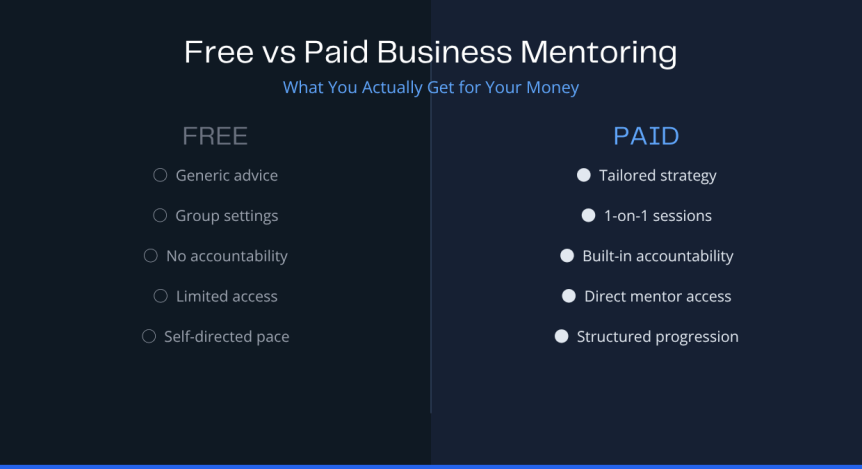
Most founders, at some point, ask whether they should pay for a business mentor when free mentoring is so widely available. It is a fair question, and the honest answer is not the one a paid mentor is supposed to give. Free business mentoring through government-backed schemes, enterprise programmes and volunteer networks is genuinely valuable, and for a great many founders, it is exactly the right place to start. The decision between free and paid mentoring is not about quality versus cheapness. It is about matching the type of support to the type of problem you actually have, and getting that match wrong wastes either your money or, more often, your time.
Here is the uncomfortable truth that the paid-mentoring industry would rather not lead with: a large proportion of founders who pay for mentoring did not need to, and would have got the same value from a free scheme. Mentoring, free or paid, is only as useful as the fit between the mentor’s experience and your specific situation, and a well-matched free mentor will outperform a poorly matched paid one every time. The question to ask is not “is paid better than free,” because that framing is wrong. The question is “what kind of support does my situation actually require,” and the answer determines which is right for you.
In more than a decade advising over 2,000 UK businesses, and as a Certified Business Mentor myself, I have seen founders thrive on free mentoring, and others waste money on paid support that did not fit. This piece sets out what free and paid business mentoring genuinely offer, when each is the right choice, and how to decide. I will be direct about when you should not pay, because telling you that honestly is the whole point.
What Free Business Mentoring Actually Offers
Free business mentoring in the UK is more substantial than many founders realise. Government-backed routes, enterprise programmes, schemes attached to startup loans, and volunteer mentor networks all provide access to experienced people who give their time without charge. The value is real: an outside perspective, accountability, the reassurance of talking to someone who has run a business, and access to networks. For an early-stage founder working through common, well-trodden challenges, this is often precisely what is needed, and the power of mentorship is not diminished by being free.
The misconception is that free means low quality. It does not. Many free mentors are highly experienced people giving back, and the structure of good schemes ensures regular, committed contact. The genuine limitations of free mentoring are distinct: the mentor may not be matched to your specific sector or situation, the relationship is general rather than tailored to a defined problem, and the mentor’s availability and depth of involvement are limited by the fact that they are volunteering. Free mentoring is broad, supportive and general, which is exactly right for broad, general-stage needs.
The SGI view, which I hold genuinely, is that founders should use free mentoring where it fits, and we say so to people who approach us when a free scheme would serve them just as well. The honest threshold is whether your need is general guidance and accountability, which free mentoring serves well, or specific, high-stakes expertise tailored to a defined problem, which it usually does not. The UK mentoring landscape is mapped in our business mentoring market report, and the picture it paints is of a sector where good free support is widely available.
A first-time founder in Newcastle, launching a service business, came to me unsure whether to pay for mentoring. Her needs were the common early-stage ones: structure, accountability, and someone to talk decisions through. I told her honestly that a free scheme would serve her well at that stage, and pointed her toward one. Paying would have bought her little she could not get for nothing.
To implement: if your needs are general guidance, accountability and perspective at an early stage, start with free mentoring. It is genuinely good, and there is no reason to pay for what you can get well for free.
What Paid Business Mentoring Adds
Paid business mentoring earns its cost when the need moves from general to specific. The things you pay for are tailored to match your exact sector and situation; the depth and continuity of involvement that a volunteer cannot always provide; accountability backed by a commercial relationship rather than goodwill; and access to specific, hard-won expertise relevant to a defined high-stakes problem. When a founder is facing a decision where getting it wrong is expensive, the value of a precisely matched, committed, expert mentor can far exceed the fee.
The misconception is that paid mentoring is simply free mentoring with a price tag, the same thing you could get for nothing. It is not, when it is the right fit. The difference is specificity and stake: a paid mentor is engaged in your particular situation, available to the depth it requires, and accountable for the relationship in a way a volunteer giving occasional time is not. The distinction matters most precisely when the stakes are highest.
The SGI approach treats paid mentoring as appropriate when the founder’s need is specific, high-stakes, and benefits from matched expertise, and as inappropriate when it is general and well served by free routes. This is the same honest threshold I apply across all our services, where roughly a third of the founders who approach us are told that a different, often cheaper or free, route would serve them better. A paid mentoring relationship is worth it when the fit is right, the stakes justify it, and not otherwise.
A founder in Edinburgh preparing for a complex situation in a regulated sector had been using a free mentor whose experience did not extend to her specific challenge. The general support had been useful, but the situation now needed matched, sector-specific expertise that the free scheme could not supply. Here, paid mentoring was the right step because the need had become specific and high-stakes in a way that free mentoring was not designed to serve.
To implement: if your need is specific and high-stakes, and would benefit from a mentor matched precisely to your situation, paid mentoring is likely to be well worth the cost. The fit and the stakes are what justify it.
How to Decide Which You Need
The decision is clearer once you stop comparing prices and start comparing fit to need. Ask what kind of support your situation actually requires. If it is general guidance, accountability and an experienced perspective, free mentoring serves it well, and you should use it. If it is specific expertise tailored to a defined, high-stakes problem, with the depth and continuity that requires, paid mentoring is likely to be worth it. If you are unsure, start free, because free mentoring costs nothing to try and will quickly reveal whether your needs exceed what it can offer.
The mistake is letting status or impatience drive the decision, paying for a mentor because it feels more serious, when a free scheme would have done. It is also a mistake to confuse mentoring with consulting; a mentor guides and challenges your thinking, while a consultant defines work for you. The distinction between a mentor and other forms of support matters, and I draw it out in startup consultant versus mentor, because hiring the wrong type of help is a common and avoidable expense.
The SGI approach, where mentoring is the right form of support, is to be honest about whether free or paid support fits the founder’s actual needs, and to point to free options that would serve just as well. Mentoring is a relationship, and the value is in the fit, not the fee.
To implement: define the support you actually need before comparing options. Match free mentoring to general needs and paid mentoring to specific, high-stakes ones, and when in doubt, start free.
Common Mistakes in Choosing Mentoring
A few errors recur. Paying for mentoring because it feels more committed, when a free scheme would have delivered the same value. Dismissing free mentoring as low quality, and missing genuinely excellent support given without charge. Choosing any mentor without checking the fit to your sector and situation, which is the single biggest determinant of value, free or paid. And confusing mentoring with consulting, and paying for guidance when you actually needed someone to do the work, or vice versa.
The founders who get the most from mentoring are not those who paid the most. They are those who matched the type and source of support to the need they actually had and were willing to use free routes where they fit.
Implementation: Choosing the Right Mentoring
Work through these in order.
- Define your actual need. General guidance and accountability, or specific high-stakes expertise. The answer drives everything.
- Map the free options. Government-backed schemes, enterprise programmes, startup loan mentoring and volunteer networks. The free landscape is broad.
- Test fit before fee. The mentor’s match to your sector and situation matters more than whether they are free or paid.
- Start free if the need is general. There is no reason to pay for what free mentoring serves well at the early, common-challenge stage.
- Consider paid when the need is specific. A well-defined, high-stakes problem that benefits from matched expertise and depth justifies the cost.
- Distinguish mentoring from consulting. A mentor guides your thinking; a consultant does the work. Match the form to the need.
- Reassess as you grow. A general need can become specific. Move from free to paid only when the need genuinely changes.
The Principle Underneath Mentoring
The value of business mentoring lies entirely in the fit between the support and the need, not in whether it is free or paid. Free mentoring is genuinely valuable and the right choice for general, early-stage needs, while paid mentoring earns its cost when the need is specific, high-stakes, and benefits from precisely matched expertise. The expensive mistake is paying for what you could get well for free, or dismissing free support as inferior when it is exactly what your situation calls for. Choose by fit to need, and you will rarely pay for what you do not require.
The right mentor is the one matched to your situation. Whether they cost anything is a far smaller question than founders tend to assume.
If your need has become specific enough that matched, committed mentoring would help, our business mentoring service provides it, and we will tell you honestly if a free scheme would serve you just as well first. As a starting point, the free business health check helps clarify whether your situation calls for general support or specific expertise.
Frequently Asked Questions
Is free business mentoring actually any good? Yes, often very good. Government-backed schemes, enterprise programmes and volunteer networks give founders access to experienced people at no cost, providing perspective, accountability and connections. The genuine limitation is not quality but fit and depth: a free mentor may not be matched to your specific sector or available to the depth a high-stakes problem requires.
When is it worth paying for a business mentor? When your need is specific, high-stakes, and benefits from a mentor matched precisely to your situation, with the depth and continuity a volunteer cannot always provide. If your needs are for general guidance and accountability at an early stage, a free scheme usually serves you just as well, and paying for it buys little extra.
What is the difference between a mentor and a consultant? A mentor guides and challenges your thinking and leaves the decisions and the doing to you, while a consultant is engaged to do defined work for you. Confusing the two is a common and expensive mistake, because paying for guidance when you needed delivery, or vice versa, means buying the wrong kind of help entirely.
How do I find free business mentoring in the UK? Through government-backed business support routes, enterprise programmes, mentoring attached to startup loan schemes, and volunteer mentor networks. The free landscape is broader than many founders realise, which is why starting free is usually sensible before deciding whether a paid relationship is warranted.
Does a more expensive mentor mean a better one? No. The single biggest determinant of value in mentoring is the fit between the mentor’s experience and your situation, not the fee. A well-matched free mentor will outperform a poorly matched paid one, so fit should always be assessed before price, regardless of the route you are considering.
Should I start with free mentoring and move to paid later? Often, yes. Free mentoring costs nothing to try and quickly reveals whether your needs exceed what it can offer. Moving to paid mentoring makes sense when, and only when, your situation becomes specific and high-stakes enough that matched, committed expertise would genuinely add value beyond what a free scheme provides.
References
- GOV.UK, business support and mentoring resources for UK businesses. https://www.gov.uk/business-support-helpline
- Federation of Small Businesses (FSB), guidance on mentoring and business support. https://www.fsb.org.uk/
- The Start Up Loans Company (British Business Bank), free mentoring included with the scheme. https://www.startuploans.co.uk/
- Department for Business and Trade, Help to Grow and related business support programmes. https://www.gov.uk/.
Related Posts

Kurt Graver is the founder and CEO of SGI Consultants, a business consultancy that has helped over 2,000 entrepreneurs establish successful startups using systematic business development methodologies. An accountant with an MBA and 25 years of commerce and consultancy experience, Kurt specialises in strategic planning, market analysis, and sustainable business growth